


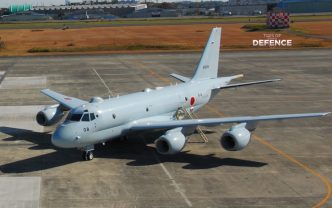
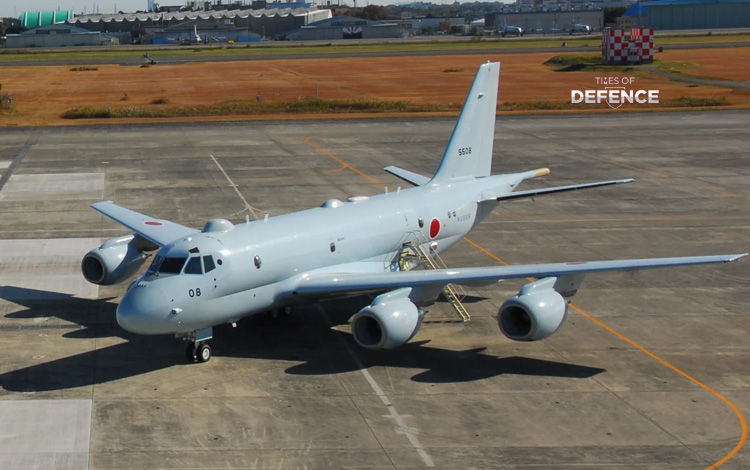
Internal investigations by Japan’s Board of Audit (BoA) alongside field reports from Japan Maritime Self-Defense Force (JMSDF) operational units have highlighted critical fleet availability deficits affecting the Kawasaki P-1 maritime patrol and anti-submarine warfare (ASW) aircraft fleet.
According to Ministry of Defense (MoD) operational audits and investigative reports by Nippon TV, only 20% to 30% of the JMSDF’s roughly 40 operational P-1 aircraft are currently mission-capable. Severe supply chain bottlenecks, component production line closures, price inflation, and environmental salt-corrosion on engine turbofans have forced maintenance units across JMSDF air wings to routinely cannibalize grounded airframes to keep active patrol sorties airborne. Furthermore, newly manufactured P-1 airframes delivered by prime contractor Kawasaki Heavy Industries (KHI) are reportedly arriving in “flight-only” baseline configurations lacking core mission avionics, functioning primarily as airframe component sources for frontline units. The Defense Ministry has targeted fiscal year 2027 to resolve the component supply deficit through long-term performance-based logistics (PBL) contracting strategies.
TECHNICAL SPECIFICATIONS: KAWASAKI P-1 MARITIME PATROL PLATFORM & FLEET BOTTLENECKS
Developer, OEM & Fleet Program Overview
⚡ Lead Platform Prime: Kawasaki Heavy Industries (KHI — Gifu, Japan)
⚡ Engine Manufacturer: IHI Corporation (IHI F7-10 high-bypass turbofan engines)
⚡ Primary Operating Units: JMSDF 3rd Air Wing (Atsugi Air Base) & 1st Air Wing (Kanoya Air Base)
⚡ Fleet Procurement Plan: 61 total planned production aircraft replacing legacy Lockheed P-3C Orions
⚡ Procurement Cost Inflation: Initial unit price of ~¥10 Billion (~$64 Million USD) inflated to ¥42.4 Billion (~$270 Million USD) in FY2024, reaching a requested ¥47.3 Billion (~$301 Million USD) per airframe in FY2026 
Airframe Engineering & Kinematic Performance
💥 Airframe Architecture: Purpose-built 4-engine low-wing composite low-observable maritime patrol aircraft
💥 Platform Dimensions: Length: 38.0 m | Wingspan: 35.4 m | Height: 12.1 m | Max Takeoff Weight (MTOW): 79,700 kg (175,700 lb)
💥 Powerplant Configuration: 4× IHI F7-10 turbofan engines producing 13,500 lbf (60 kN) thrust each
💥 Flight Kinematics: Max Speed: 996 km/h (538 knots) | Cruise Speed: 833 km/h (450 knots) | Operational Ceiling: 44,200 ft (13,520 m) | Range: 8,000 km (4,320 nmi)
Sensors, Mission Avionics & Weaponry Capabilities
🚀 Surface/Air Radar: Toshiba HPS-106 Active Electronically Scanned Array (AESA) radar (3-antenna array providing 360-degree detection)
🚀 ASW Acoustic Suite: Advanced acoustic signal processing suite tracking multi-static passive/active sonobuoys
🚀 Magnetic Anomaly Detection (MAD): CAE AN/ASQ-508(V) MAD sensor mounted on stinger boom tail
🚀 Fly-by-Light (FBL) Flight Control: World’s first operational military aircraft utilizing Fly-by-Light fiber-optic flight control links to eliminate electromagnetic interference (EMI) with onboard radar/MAD sensors
🚀 Internal Bay & Underwing Payload: Internal weapons bay plus 8 external wing hardpoints carrying up to 9,000 kg (20,000 lb) total ordnance (Type 91 / AGM-84 Harpoon anti-ship missiles, AGM-65 Maverick, MK-46 / Type 12 light torpedoes, and depth charges)
Root Causes of Low Availability & Logistics Failures
🚀 F7-10 Engine Corrosion: Low-altitude maritime patrol profiles expose IHI F7-10 engines to high airborne salt content, causing severe internal turbine blade corrosion and premature failures
🚀 Lead-Time Delays: Over 30% of critical replacement electronics and semiconductors suffer delivery delays exceeding 12 months post-order placement
🚀 Out-of-Production Components: Discontinued tier-2 and tier-3 supplier parts require custom re-engineering or cannibalization from newly delivered airframes
TIMES OF DEFENCE ASSESSMENT
The operational crisis affecting Japan’s Kawasaki P-1 fleet reveals the structural vulnerabilities of specialized, low-volume sovereign defense hardware. Designed from the ground up to replace the aging P-3C Orion, the P-1 represents a technological achievement—featuring four IHI F7-10 turbofans, an advanced Fly-by-Light (FBL) control system, and 360-degree AESA radar coverage tailored for East Asian maritime chokepoint surveillance. However, maintaining a highly bespoke platform with a small domestic production run leaves the fleet vulnerable to global supply chain shocks.
From an engineering and sustainment perspective, the P-1’s operational bottlenecks stem from its high-cost specialized components and harsh operational environment. Frequent low-altitude ASW patrols expose the engines to aggressive atmospheric salt corrosion, accelerating maintenance cycles faster than domestic depot supply chains can deliver replacement turbofan components. With unit costs rising to over ¥47 Billion ($300+ Million USD), the Defense Ministry faces a difficult operational choice: continue funding expensive single-airframe buys, or shift capital toward long-term spare parts inventory, performance-based logistics (PBL), and uncrewed long-endurance maritime surveillance drones (such as the MQ-9B SeaGuardian) to relieve pressure on the crewed P-1 fleet.

