


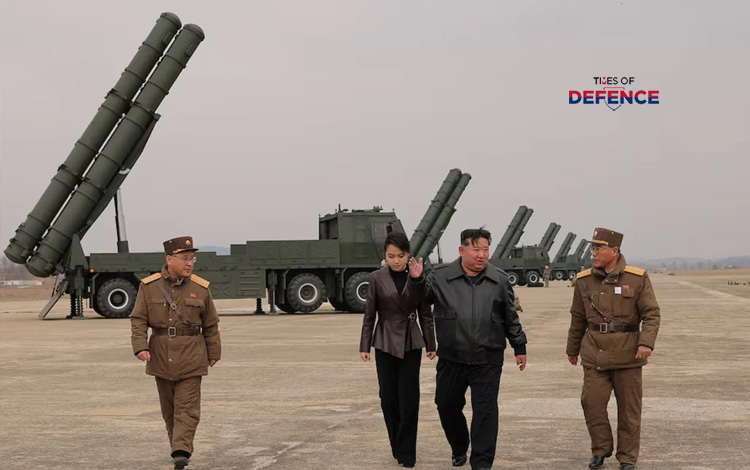
Leak reports detailing computer-assisted Command Post Exercise (CPX) outcomes from the truncated Ulchi Freedom Shield 2026 (UFS-26) exercise indicate a conventional military breakthrough by Korean People’s Army (KPA) forces, penetrating combined ROK-U.S. defense belts and advancing toward the northern suburbs of Seoul.
According to reporting by Chosun Ilbo on October 15, 2026, the wargame scenario evaluated a purely conventional KPA blitzkrieg without nuclear or strategic chemical release. The simulated frontline breach has intensified political debate over the transfer of Operational Control (OPCON) from U.S. Forces Korea (USFK) to the South Korean military. Concurrently, KPA frontline units have initiated tactical posturing, including the overt coastal deployment of 122mm self-propelled artillery units in Kaepung County and the covert laying of plastic landmines along Demilitarized Zone (DMZ) patrol routes.
TECHNICAL SPECIFICATIONS: ROK-U.S. COMBINED DEFENSE & KPA FRONTLINE ARTILLERY
Exercise Simulation & OPCON Transition Architecture
⚡ Exercise Designation: Ulchi Freedom Shield 2026 (UFS-26 / Executed Aug 17–21, 2026; truncated by 6 days)
⚡ Commanding Command Structure: ROK/US Combined Forces Command (CFC) / ROK Ground Operations Command (GOC)
⚡ Key Leadership: General Xavier T. Brunson (Commander, UNC/CFC/USFK) & Kang Shin-chul (ROK Minister of National Defense)
⚡ C4ISR Deficit Identifier: ROK military lacks autonomous real-time tracking of KPA Mobile Missile Launchers (TELs) without U.S. satellite constellation & high-altitude recon (RQ-4 Global Hawk / U-2S) integration, creating structural vulnerabilities in ROK’s pre-emptive “Kill Chain” strike doctrine 
KPA Coastal Deployments & Artillery Engineering (Kaepung Sector)
💥 Primary Artillery Platform: KPA 122mm Self-Propelled Howitzer (M-1977/M-1985 Variant on tracked/wheeled chassis)
💥 Tactical Location: Kaepung County coast, North Hwanghae Province (~1.5 km across the Han River estuary from Gimpo Aegibong)
💥 Ballistic Kinematics:
• Ammunition Types: HE-FRAG, smoke, chemical, and cargo submunition projectiles
• Range Profile: 15.3 km (standard HE) to 24 km (Rocket-Assisted Projectile / RAP)
• Rate of Fire: 4–6 rounds per minute (burst) | 1–2 rounds per minute (sustained)
💥 Operational Anomaly: Unhedged open-terrain positioning without camouflage nets or revetments, utilizing signal flags (red flag raising/lowering) for manual gun-line battery alignment
DMZ Mine Warfare & Tactical Provocations
🚀 Munition Identification: KPA Leaf/Box Plastic Anti-Personnel Mines (Non-metallic / Low-metal content construction)
🚀 Tactical Infiltration Metric: Buried ~10 meters south of the Military Demarcation Line (MDL) inside ROK 25th Infantry Division patrol corridors
🚀 Detection Resistance: Low-metal body casing severely degrades electromagnetic induction mine-detector performance (AN/PSS-14 / PRS-17K), requiring ground-penetrating radar (GPR) or visual probe techniques
TIMES OF DEFENCE ASSESSMENT
The reported UFS-26 wargame simulation failure highlights structural operational gaps within the ROK-U.S. combined defense posture along the Korean Peninsula. For decades, South Korean defense doctrine relied on dense defense-in-depth fortifications, qualitative artillery counter-battery superiority, and U.S. air dominance to absorb and halt a conventional KPA assault north of the Han River. However, simulated KPA breakthroughs toward Seoul’s perimeter indicate that KPA mechanized updates, massed tube/rocket artillery saturation, and modified maneuver tactics could threaten allied defensive lines if command structures or reaction windows lag.
From an engineering and strategic perspective, the political push by President Lee Jae-myung’s administration for a rapid wartime OPCON transfer faces operational friction. As USFK Commander Gen. Xavier Brunson noted, effective OPCON transition requires sovereign ROK C4ISR capabilities capable of real-time target acquisition against mobile threats. Until South Korea deploys its own low-Earth orbit (LEO) military reconnaissance satellite constellation and autonomous strike chains to replace U.S. national technical means (NTM), executing the “Kill Chain” doctrine during a high-tempo KPA offensive remains vulnerable to operational delays.

