


The Defense Advanced Research Projects Agency (DARPA) has completed its first end-to-end tactical demonstration linking satellite imagery detection to autonomous ground maneuver and human-in-the-loop strike execution.
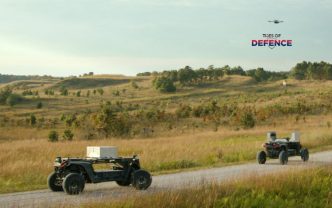
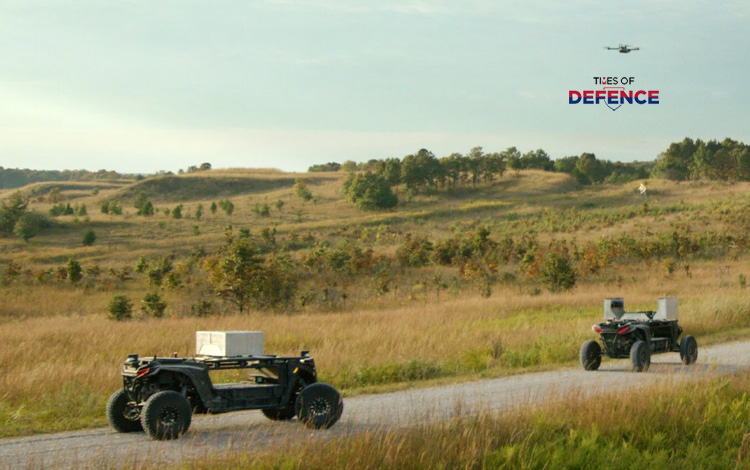
Executed on October 15, 2026, at Fort Knox’s St. Vith Range in response to an operational requirement from U.S. European Command (USEUCOM), the live experiment evaluated a team of four autonomous Unmanned Ground Vehicles (UGVs)—comprising Overland AI platforms integrated with Anduril one-way attack loitering munitions—running software developed under DARPA’s Robotic Autonomy in Complex Environments with Resiliency (RACER) program. The test validated an automated C2 kill chain where satellite imagery cued a four-vehicle UGV team to autonomously navigate off-road terrain, perform leapfrog tactical maneuvers, detect simulated enemy assets, and relay targeting optics back to a human operator for final kinetic strike authorization.
TECHNICAL SPECIFICATIONS: DARPA RACER AUTONOMY & INTEGRATED UGV STRIKE ARCHITECTURE
Sponsoring Authority, Software Baseline & Operational Context
⚡ Executing Agency: Defense Advanced Research Projects Agency (DARPA / Tactical Technology Office)
⚡ Core Autonomy Architecture: RACER (Robotic Autonomy in Complex Environments with Resiliency) Software Stack
⚡ Platform Hardware Integrators: Overland AI (Autonomous Ground Vehicles) & Anduril Industries (Airborne Loitering Munitions / Lattice C2 Suite)
⚡ Requesting Operational Command: U.S. European Command (USEUCOM — evaluating forward robotic screening for eastern NATO deterrence lines) 
Maneuver Platforms & Onboard Sensor Hardware
💥 Mobility Hardware Baseline: Overland AI “ULTRA” / RACER Fleet Vehicles (custom drive-by-wire off-road platforms)
💥 Onboard Perception Suite: Multi-spectral LiDAR arrays, optical/IR stereo cameras, and radar modules integrated with high-performance edge computing units
💥 Autonomous Mobility Kinematics: High-speed off-road traversal across unstructured terrain, steep inclines, and dense vegetation without GPS/GNSS reliance
💥 Target Processing: Computer vision algorithms executing real-time obstacle map generation and target classification at operational driving speeds
Sensor-to-Shooter Kill Chain & Human-in-the-Loop Architecture
🚀 C4ISR Integration Phase 1 (Satellite Cueing): 10-digit grid coordinates derived from overhead satellite imagery transmitted directly to the UGV team C2 interface
🚀 Phase 2 (Tactical Autonomous Maneuver): Lead UGV advances along mobility corridors while wingman UGVs execute bounded overwatch covering positions
🚀 Phase 3 (Target Detection & Verification): Onboard optical sensors detect hostile threat at ~275 meters (300 yards); high-resolution image telemetry relayed to human operator
🚀 Phase 4 (Human-Authorized Engagement): Operator reviews target image and approves strike; lead vehicle deploys an onboard Anduril drone payload for aerial verification/kinetic impact
Payload Integration & Future Development Roadmap
🚀 Integrated Payloads: Onboard enclosed launch canisters housing Anduril loitering munitions, electronic warfare (EW) jammers, and remote reconnaissance drones
🚀 Next Testing Milestone: December 2026 soldier-in-the-loop operational assessment to refine tactical TTPs and autonomous team behaviors
TIMES OF DEFENCE ASSESSMENT
DARPA’s successful integration of satellite imagery cues with RACER-powered autonomous UGVs at Fort Knox marks a key transition from basic off-road mobility research to multi-domain tactical teaming. Organically linking overhead satellite intelligence to autonomous ground robots addresses the critical military challenge of forward reconnaissance in high-threat, contested environments.
From an engineering and operational perspective, the strength of the RACER architecture lies in its platform-agnostic off-road perception stack combined with strict human-in-the-loop command protocols. While the UGVs handle pathfinding, obstacle avoidance, bounding overwatch, and target detection autonomously, final engagement authority remains firmly with the human operator—ensuring compliance with DoD autonomous weapons directives. By pairing Overland AI ground vehicles with Anduril drone payloads, DARPA provides USEUCOM with a viable blueprint for automated screening forces capable of operating beyond the forward line of own troops (FLOT) to identify and engage enemy targets without placing human soldiers in direct danger.

