


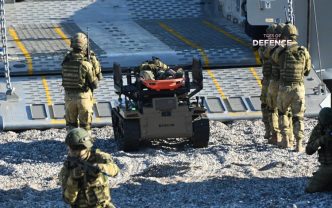
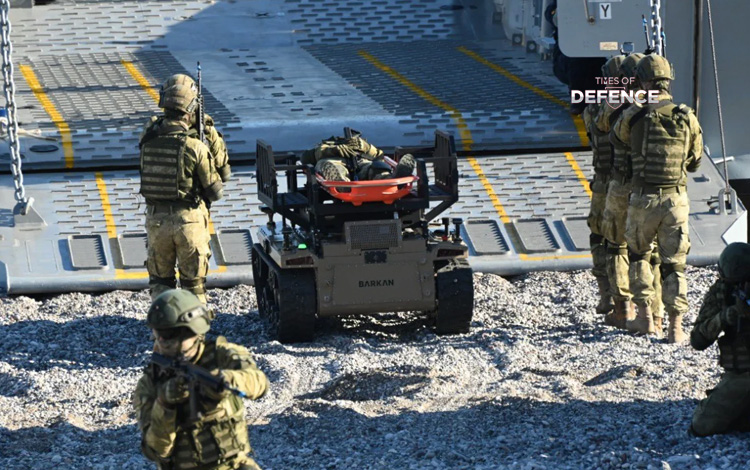
The Turkish Naval Forces Command (Türk Deniz Kuvvetleri) has successfully integrated HAVELSAN’s Barkan medium-class unmanned ground vehicle (UGV) into amphibious assault, beachhead clearance, urban warfare, and automated casualty evacuation (CASEVAC) operations during Exercise TURNAs-2026.
Executed between October 19 and 27, 2026, across maritime and coastal maneuver zones in the Gulf of Antalya, the joint exercise evaluated cross-domain tactical integration between crewed naval landing forces and autonomous uncrewed surface, underwater, aerial, and land platforms. During the amphibious raid scenario, Barkan UGVs deployed directly from naval landing craft (LCM/LCVP) onto simulated hostile beachheads alongside Turkish Marine Brigade infantry assault elements. The vehicles provided forward tactical reconnaissance, direct fire support, and structural breach covering fire before transitioning to automated wounded extraction—transporting simulated casualties from urban combat zones back to beachhead aid stations. Developed under HAVELSAN’s “Digital Unit” (Dijital Birlik) framework, the deployment validates joint multi-domain swarming capabilities connecting land robotics with naval C2 architectures.
TECHNICAL SPECIFICATIONS: HAVELSAN BARKAN UGV PLATFORM FAMILY
Developer, Program Lineage & Mass Production Status
⚡ Lead Systems Integrator: HAVELSAN A.Ş. (Ankara, Türkiye)
⚡ Procurement Authority: Türkiye Presidency of Defense Industries (SSB — Savunma Sanayii Başkanlığı)
⚡ Inventory & Production Milestone: Entered Turkish Armed Forces inventory in 2023; mass production initiated in 2025; Barkan 3 configuration unveiled at SAHA Expo 2026
⚡ Operating Architecture: HAVELSAN Digital Unit Concept — AI-driven C2 software linking UGVs, UAVs, and USVs into unified tactical swarms 
Airframe Engineering & Kinematic Performance
💥 Mobility Architecture: Heavy-duty rubber-tracked chassis featuring high-clearance suspension built for amphibious beachhead mud, sand, and urban rubble
💥 Platform Dimensions & Mass:
• Barkan 1 Baseline: Unladen Mass: 380–400 kg | Dimensions: 1.45 m × 0.90 m × 1.00 m
• Barkan 2 Variant: Unladen Mass: 750 kg | Payload Mass: 200–400 kg
• Barkan 3 Heavy Variant: Unladen Mass: 1,000 kg (1 tonne) | Length: 2.7 m | Ground Clearance: 35 cm obstacle clearance
💥 Propulsion & Powerplant: All-electric / hybrid powertrain driving low-noise electric motors; top speed up to 12–25 km/h depending on configuration
💥 Obstacle Negotiation: Capable of scaling 35 cm vertical steps, crossing 60 cm trenches, and traversing 60% side slopes
Modular Payload, Armament & Sensor Suite
🚀 Modular Mission Packs: Swappable top-deck interfaces configured for remote weapon stations (RCWS), CASEVAC stretcher mounts, EOD robotic arms, or cargo logistics
🚀 Integrated Weapon Systems: Can be armed with 7.62mm / 12.7mm machine gun RCWS, 40mm automatic grenade launchers, Roketsan CİRİT 70mm laser-guided missiles, or KARAOK anti-tank guided missiles (ATGMs)
🚀 Airborne Drone Launch: Deck-mounted launching canister deploying tethered or free-flying micro-UAVs for organic over-the-hill aerial ISR
🚀 C4I Navigation & Autonomy Suite: 360-degree EO/IR camera array, millimeter-wave radar, lidar sensor fusion, and AI-assisted “Return-to-Home” (RTH) autonomous route memorization in GNSS-denied environments
TIMES OF DEFENCE ASSESSMENT
The Turkish Naval Forces’ integration of the HAVELSAN Barkan UGV during Exercise TURNAs-2026 demonstrates how autonomous ground robotics are reshaping initial-wave amphibious assault tactics. Historically, amphibious landings represent among the highest-risk maneuvers in military operations, exposing assault troops to concentrated beachhead fire and dense obstacle belts. Deploying tracked, armed UGVs alongside first-wave landing craft allows commanders to establish automated beachhead security and execute dangerous breach operations without placing Marines in direct line of fire.
From an engineering and operational perspective, the strength of the Barkan system lies in its multi-mission adaptability and swarming autonomy. By utilizing HAVELSAN’s “Digital Unit” C2 network, the UGV shares target tracking data with offshore surface combatants, amphibious assault ships (such as TCG *Anadolu*), and overhead UAVs in real time. Furthermore, offloading last-mile casualty evacuations (CASEVAC) from high-risk urban assault zones to autonomous UGVs reduces medical extraction delays while preserving frontline infantry strength during high-intensity littoral engagements.

