


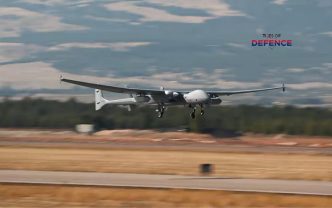
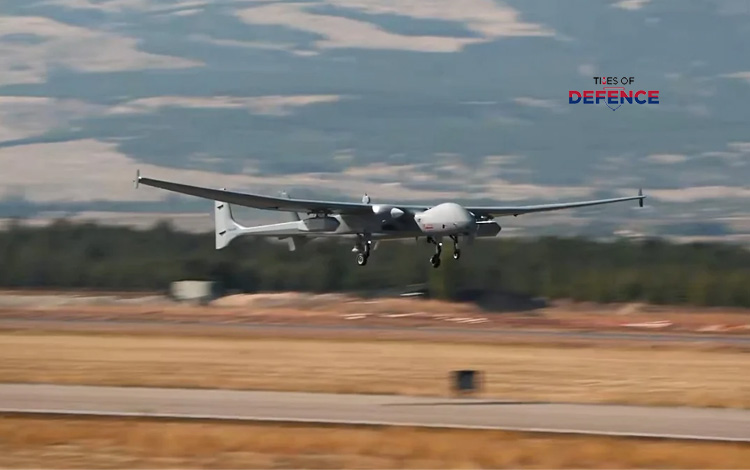
Turkish Aerospace Industries (TUSAŞ) and ASELSAN have successfully demonstrated aerial deployment and signal processing of passive directional sonobuoys from the Aksungur Medium-Altitude Long-Endurance (MALE) Unmanned Aerial System (UAS) during the Turkish Naval Forces’ TURNAs-2026 uncrewed maritime systems exercise.
Powered by indigenous TEI-PD170 turbodiesel engines and operating under Beyond Line-of-Sight (BLOS) satellite communications (SATCOM), the Aksungur flew from Ankara to the Gulf of Antalya engagement zone. The aircraft descended to 1,000 feet to deploy three ASELSAN aselBUOY 100P passive directional sonobuoys alongside a standard reference sonobuoy directly into Mediterranean waters via external pod launchers. The UAS subsequently climbed to 6,000 feet to establish an RF relay link, monitoring acoustic telemetry over a four-hour mission window and transmitting real-time hydroacoustic sensor data back to an Ankara-integrated Ground Control Station (GCS) and acoustic processing center. The milestone marks the first operational air-launch and acoustic relay execution of the aselBUOY 100P platform from an unmanned aerial asset.
TECHNICAL SPECIFICATIONS: TUSAŞ AKSUNGUR & ASELSAN aselBUOY 100P ASW SUITE
Developer, OEM & System Integrators
⚡ Primary Aircraft Integrator: Turkish Aerospace Industries (TUSAŞ — Ankara, Türkiye)
⚡ Sonobuoy & Acoustic Processing OEM: ASELSAN A.Ş. (Ankara, Türkiye)
⚡ Engine Manufacturer: TEI (TUSAŞ Engine Industries — Eskişehir, Türkiye)
⚡ Sponsoring Operational Command: Turkish Naval Forces Command (Türk Deniz Kuvvetleri) / TURNAs-2026 Exercise 
Aksungur UAS Performance Parameters & ASW Payload Integration
💥 Powerplant Architecture: 2× TEI-PD170 twin-turbocharged inline-4 turbodiesel engines generating 170 hp each
💥 Flight Envelope & Endurance: Max Operational Ceiling: 40,000 ft | Mission Endurance: >50 hours (30+ hours carrying full 750 kg weapon/sensor loadout) | Max Payload Mass: >750–1,250 kg
💥 Satellite C2 Link: Integrated Ku/Ka-band SATCOM antenna providing continuous BLOS satellite C2 and high-throughput sensor telemetry transmission
💥 ASW Launch Pod Configuration: Underwing sonobuoy dispenser pod capable of carrying and releasing NATO A-size / B-size sonobuoy canisters in pneumatic or gravity-drop profiles
ASELSAN aselBUOY 100P Sonobuoy System Architecture
🚀 Form Factor & Physical Metrics: NATO A-size standard canister | Mass: ~10 kg (22 lb)
🚀 Acoustic Sensor Technology: Passive directional acoustic hydrophone array operating across low/medium/high frequency submarine noise bands
🚀 Operating Depth Profiles: Selectable hydrophone deployment depth settings at 30 meters (98 ft) or 150 meters (492 ft)
🚀 RF Data Link & Operating Endurance: Very High Frequency (VHF) radio transmitter link providing operational telemetry transfer ranges up to 20 km (12 miles); programmed operating life up to 8 hours prior to automated scuttling
C4ISR & Acoustic Processing Architecture
🚀 Acoustic Data Chain: Hydrophone → Surface RF Antenna → Aksungur airborne relay node → SATCOM link → Ankara Ground Control Station & Naval Acoustic Processing Center
🚀 AI Acoustic Modeling: Integrated AI-driven acoustic target identification models trained to isolate submarine propeller cavitation, engine tonals, and hull signatures from ambient ocean noise
TIMES OF DEFENCE ASSESSMENT
The aerial deployment of aselBUOY 100P sonobuoys from the Aksungur MALE UAS during TURNAs-2026 represents an operational milestone for unmanned Anti-Submarine Warfare (ASW) doctrine. Historically, broad-area ASW search operations relied on crewed Maritime Patrol Aircraft (MPA)—such as the ATR-72 600 TMPA or P-8A Poseidon—or ship-borne SH-70 Seahawk helicopters. While highly capable, crewed platforms are constrained by crew fatigue, higher operating costs per flight hour, and limited on-station loiter times.
From an engineering and force-structure perspective, deploying sonobuoys from a 50+ hour endurance UAS changes the operational economics of submarine hunting. Operating under satellite control with indigenous TEI-PD170 turbodiesel power, the Aksungur can transit to contested choke points, deploy sonobuoy fields over suspected submarine vectors, and serve as an airborne RF processing hub for hours. Offloading long-duration acoustic monitoring to unmanned assets allows navies to preserve crewed MPAs for high-priority command-and-control or kinetic engagement missions, establishing a continuous, low-cost acoustic surveillance curtain across critical maritime domains like the Aegean and Eastern Mediterranean.

