


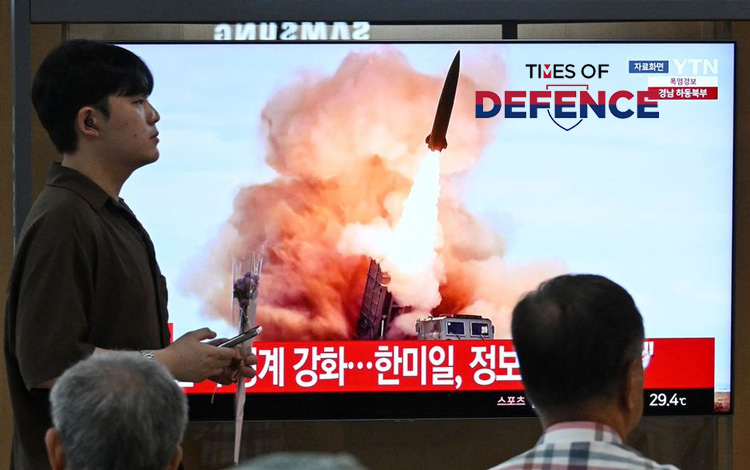
SEOUL / TOKYO — North Korea conducted two short-range ballistic missile (SRBM) tests off its eastern coast on September 20, 2026. According to South Korea’s Joint Chiefs of Staff (JCS), the first missile was launched from the coastal Wonsan region at approximately 3:00 PM local time and traveled roughly 450 kilometers (280 miles). Approximately three hours later, at around 6:00 PM, a second projectile was fired from the same area, traversing a distance exceeding 600 kilometers before impacting the East Sea (Sea of Japan).
South Korean military authorities assess that the initial launch likely involved a variant from North Korea’s Hwasong-11 (KN-23 / KN-24) series of solid-fueled tactical ballistic missiles. Japan’s Ministry of Defense confirmed the ballistic nature of the launch, reporting that the projectiles splashed down outside Japan’s Exclusive Economic Zone (EEZ). U.S. Indo-Pacific Command stated that current assessments indicate the tests pose no immediate threat to U.S. personnel, territory, or regional allies, while allied intelligence agencies continue close multi-national monitoring.
TECHNICAL SPECIFICATIONS: HWASONG-11 (KN-23 / KN-24) SERIES SRBM
* Missile Class: Short-Range Ballistic Missile (SRBM) / Tactical Ballistic Missile
* Propulsion Type: Single-stage, solid-propellant rocket motor enabling rapid road-mobile deployment and reduced launch preparation time
* Flight Profile: Low-altitude quasi-ballistic trajectory (apogee typically between 35 km and 60 km) with terminal aero-fin maneuvering (“pull-up” capability) engineered to complicate interception by modern air defense networks like Patriot PAC-3 and THAAD
* Operational Range: Scalable range from 400 km up to 700+ km depending on payload weight (450 km registered on test 1; >600 km registered on test 2)
* Payload Capacity: Estimated warhead capacity ranging from 500 kg to 1,500 kg, designed for heavy conventional high-explosive, submunition, or tactical nuclear payloads
* Guidance & Control: Inertial Navigation System (INS) augmented by satellite updates and aerodynamic control vanes
* Launch Systems: Highly mobile platforms including 4-axle wheel-based Transporter Erector Launchers (TELs), tracked launchers, and rail-car launch systems
The staggered testing highlights Pyongyang’s ongoing efforts to demonstrate rapid salvo capability and operational flexibility using solid-fuel short-range tactical strike assets.
