


U.S. Navy Carrier Strike Group Repositions After Nearly Seven Months in the Middle East
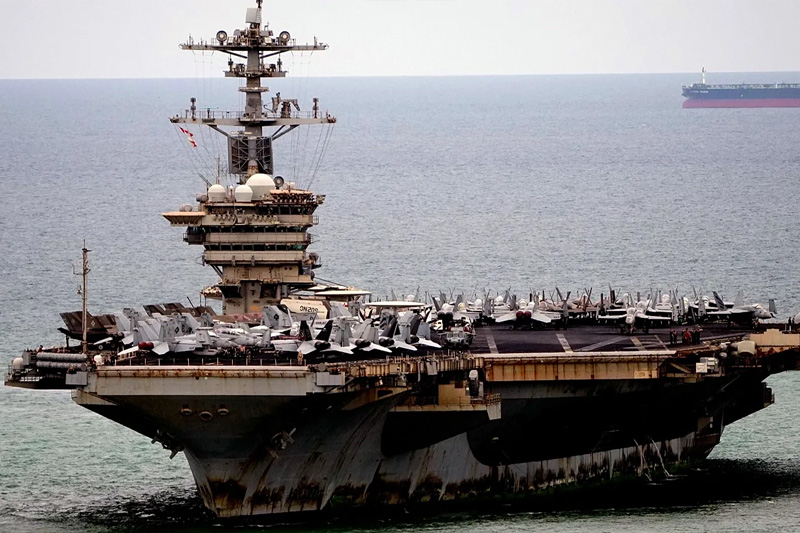
The U.S. Navy’s USS Abraham Lincoln (CVN-72) has returned to the Indo-Pacific following an exceptionally long deployment in the Middle East, using Guam as a key logistics and sustainment point during its journey back to the Pacific.
The Nimitz-class nuclear-powered aircraft carrier arrived at Apra Harbor, Guam, on September 19, 2026, alongside the Arleigh Burke-class guided-missile destroyer USS Frank E. Petersen Jr. (DDG-121).
The ships were joined by the embarked staffs of Carrier Air Wing 9 (CVW-9) and Destroyer Squadron 21. The Guam stop was described by the U.S. Navy as a brief logistics visit before the strike group continued its operations in the U.S. 7th Fleet area of operations.
A 302-Day Deployment
The Abraham Lincoln Carrier Strike Group’s current deployment began with its departure from San Diego in November 2025.
By the time the carrier reached Guam, the deployment had reached approximately 302 days, including nearly seven months operating in the U.S. Central Command region.
USNI News described the deployment as the second-longest U.S. carrier deployment since the end of the Cold War, behind the USS Gerald R. Ford’s 326-day deployment.
The carrier’s crew also spent approximately 208 consecutive days at sea, according to Stars and Stripes, with the Guam stop marking the first return to U.S. territory for the strike-group personnel in about nine months.
Before reaching Guam, elements of the strike group made a scheduled port visit to Thailand from September 2–6, including Laem Chabang and Sriracha.
Why Guam Matters
The Guam stop was more than a crew-rest opportunity.
The island is a critical U.S. military logistics and command hub in the western Pacific.
Its location allows the U.S. Navy to support forward-deployed forces operating across the Indo-Pacific without requiring every major combatant to return to the U.S. West Coast for routine sustainment.
The U.S. Navy specifically describes Guam as a critical nexus for:
- Command and control
- Logistics
- Maintenance and support
- Forward power projection
- Sustainment of carrier strike groups
During the Lincoln’s September 19 stop, the carrier took on stores, mail and equipment before departing the following day.
This illustrates an important feature of U.S. naval operations: major combat power is sustained not only by the ships themselves, but by a network of forward bases, ports, logistics vessels and support infrastructure.
USS Abraham Lincoln: The Carrier
USS Abraham Lincoln is the fifth Nimitz-class aircraft carrier and was commissioned in 1989.
The nuclear-powered carrier is designed to operate a large embarked air wing while supporting sustained operations far from the United States.
Key specifications
| Characteristic | USS Abraham Lincoln |
|---|---|
| Class | Nimitz-class |
| Designation | CVN-72 |
| Commissioned | November 11, 1989 |
| Length | 1,092 ft / 333 m |
| Beam | 252 ft / 76.8 m |
| Displacement | Approx. 95,000 tons |
| Propulsion | Nuclear |
| Speed | 30+ knots |
| Aircraft capacity | 65+ aircraft |
| Ship’s company | Approx. 2,800 |
| Air wing personnel | Approx. 2,000 |
| Homeport | San Diego, California |
The Navy’s current ship briefing lists a 4.5-acre flight deck and the ability to operate more than 65 aircraft.
The nuclear propulsion system provides the carrier with exceptionally long endurance. Unlike conventionally powered ships, the carrier does not need to periodically refuel its propulsion plant with conventional marine fuel.
Its operational endurance is instead constrained by factors such as aviation fuel, ammunition, food, spare parts, maintenance and crew requirements.
The Air Wing Returning to the Pacific
Embarked aboard Abraham Lincoln is Carrier Air Wing 9, one of the U.S. Navy’s most capable carrier air wings.
Current Navy information identifies CVW-9 as operating:
- F-35C Lightning II
- F/A-18E/F Super Hornet
- EA-18G Growler
- E-2D Advanced Hawkeye
- CMV-22B Osprey
- MH-60R/S Seahawk
The current organizational structure lists eight squadrons, reflecting changes in the air wing’s composition compared with its 2024 deployment.
F-35C Lightning II
The carrier air wing’s F-35C provides a stealthy fifth-generation combat capability.
Its role includes:
- Long-range sensing
- Air-to-air combat
- Precision strike
- Target identification
- Intelligence, surveillance and reconnaissance
- Networked operations
The carrier’s F-35Cs can also contribute to the strike group’s broader sensor network, sharing information with other aircraft and ships.
F/A-18E/F Super Hornet
The Super Hornet remains the primary multirole fighter component of the carrier air wing.
It can perform:
- Air superiority
- Escort
- Precision strike
- Maritime strike
- Suppression of enemy air defenses
- Tanking
- Reconnaissance-related missions
The aircraft provides the carrier with a large number of flexible combat platforms capable of carrying a wide range of air-to-air and air-to-surface weapons.
EA-18G Growler
The EA-18G Growler adds an electronic-warfare capability.
It is designed to detect, locate and disrupt hostile radar and communications systems while supporting the carrier air wing’s strike aircraft.
This makes electronic warfare an integrated component of the carrier’s offensive and defensive architecture rather than a separate mission.
E-2D Advanced Hawkeye
The E-2D provides airborne early warning and command-and-control capabilities.
Its powerful radar allows the carrier strike group to extend its ability to detect and track airborne and surface targets beyond the immediate horizon.
This aircraft effectively functions as the air wing’s airborne sensor and battle-management node.
MH-60R/S Seahawk
The helicopter component provides maritime and support capabilities including:
- Anti-submarine warfare
- Surface surveillance
- Search and rescue
- Logistics
- Personnel recovery
- Vertical replenishment and support
Together, these aircraft create a layered carrier aviation architecture rather than simply a collection of fighter jets.
The Carrier Strike Group
Abraham Lincoln does not operate alone.
The current Carrier Strike Group 3 structure includes the carrier, CVW-9, the embarked Carrier Strike Group 3 and Destroyer Squadron 21 staffs, and Arleigh Burke-class guided-missile destroyers.
USS Frank E. Petersen Jr. accompanied Lincoln into Guam.
The Burke-class destroyers provide important capabilities including:
- Long-range air defense
- Ballistic-missile defense
- Anti-surface warfare
- Anti-submarine warfare
- Land-attack capability
- Strike-group escort
The combination of the carrier’s aircraft and the destroyers’ missile systems creates a layered defensive and offensive network around the carrier.
From CENTCOM Back to 7th Fleet
The Lincoln’s repositioning is strategically significant because it returns a major U.S. naval aviation force to the Indo-Pacific after an extended period in the Middle East.
The carrier had spent much of its deployment supporting U.S. operations in the Central Command area.
Now, Carrier Strike Group 3 is conducting routine operations under the U.S. 7th Fleet.
The Navy describes the mission as supporting a free and open Indo-Pacific while operating with U.S. allies and partners.
The timing also places a highly capable carrier strike group back in the western Pacific as the U.S. Navy continues to manage competing operational demands between the Indo-Pacific and Middle East.
The Logistics Challenge
The Abraham Lincoln’s unusually long deployment demonstrates another increasingly important aspect of modern naval warfare:
Sustainment can be just as important as combat power.
A carrier strike group requires enormous quantities of:
- Aviation fuel
- Aircraft spare parts
- Food and water
- Precision-guided weapons
- Conventional ammunition
- Engine and machinery components
- Maintenance equipment
- Medical supplies
A carrier cannot remain continuously combat-capable simply because its nuclear reactor provides virtually unlimited propulsion endurance.
Its aircraft still consume fuel and weapons, while thousands of personnel require continuous logistical support.
That is where facilities such as Guam become critical.
Guam as a Forward Logistics Hub
Guam’s geographic position provides the U.S. Navy with a strategically located support point between the western Pacific and the U.S. mainland.
For carrier strike groups, Guam can provide a combination of:
logistics + maintenance + communications + crew support + operational access.
The Lincoln’s September stop demonstrated this role directly.
The carrier arrived after months of operations, received stores and equipment, allowed personnel access to base facilities and then continued its voyage.
The brief nature of the stop also demonstrates that forward bases do not necessarily need to become lengthy deployments or major maintenance periods. They can function as rapid sustainment nodes within a wider operational network.
What Comes Next?
The Abraham Lincoln has now departed Guam and continues its return toward the U.S. West Coast.
USNI News reported that the carrier is expected to reach the West Coast in early October, although the exact schedule can change according to operational requirements.
For the Indo-Pacific, the significance is therefore temporary but notable: the carrier is operating in the 7th Fleet area during the final phase of an unusually long global deployment.
The larger lesson is about naval endurance.
Modern carrier warfare depends on more than the carrier itself.
It requires an integrated system of aircraft, escorts, sensors, weapons, logistics ships and forward bases capable of keeping the force operational thousands of miles from home.
Guam remains one of the critical pieces of that system.
Editorial note: The September 2026 Guam visit was a brief logistics stop, not a permanent redeployment of USS Abraham Lincoln to Guam or a new homeporting arrangement. The carrier has since departed and is continuing toward its San Diego homeport.
